The big news, to me, this week is that Google published a paper announcing that they have achieved RSI (recursive self-improvement) and explained how they did it. As a reminder, Google is the company who invented the attention mechanism that allows large language models to work in the first place. When they did that, they quietly published a paper about it, but did not release any products based on the idea. Eventually, someone at OpenAI discovered that paper, applied it’s techniques to their own project and ChatGPT was born… and then everyone else jumped on the bandwagon.
In this week’s newsletters, I’ll link to the paper, briefly explain its concepts, and show what I consider to be proof that Google has actually achieved this milestone.
This is an exciting time full of a lot of uncertainty. No one knows how this stuff will play out. We’re going to have to figure it out together.
1. LLMs are just stochastic parrots. 2. Fine, articulate parrots. Still just predicting the next word. 3. They can’t even multiply. 4. Fine, they can multiply. Try olympiad math. 5. Fine, they can compete. Try winning gold. 6. Fine, gold. Someone already knew the answers. 7. Fine, an open problem. Try a Millennium Prize Problem. 8. Fine, but it wasn’t Riemann. 9. Fine, Riemann. but did it understand the proof? 10…
My husband just walked in to see if I was working on something important or open to hanging out. Turns out, he ran out of tokens for a few hours so this is the window for us to go do something.
This post has bonus content for paid subscribers. Upgrade to get full access.
He commemorated mathematician Levant Alpöge’s use of Anthropic’s Claude model to solve the Riemann Hypothesis with an essay titled Superintelligence is Arriving.
In this essay Wang talks about how momentous this accomplishment is, how difficult it was to solve, and what it heralds i.e., the arrival of superintelligent models capable of self-improvement. He writes:
Notably, this is likely true of AI research. Most researchers would agree that AI research is certainly much less intellectually demanding than solving the Riemann Hypothesis. The models are clearly going to be intelligent enough to automate all of AI research and be clearly superhuman at improving themselves—along with massively accelerating biological research, weapons research, economics research, and more. The implications are enormous. In the same way that the math community has not fully digested the proof of the Riemann Hypothesis, nearly every field could be accelerated at a pace beyond what humans can understand or monitor.
Google Unlocks RSI
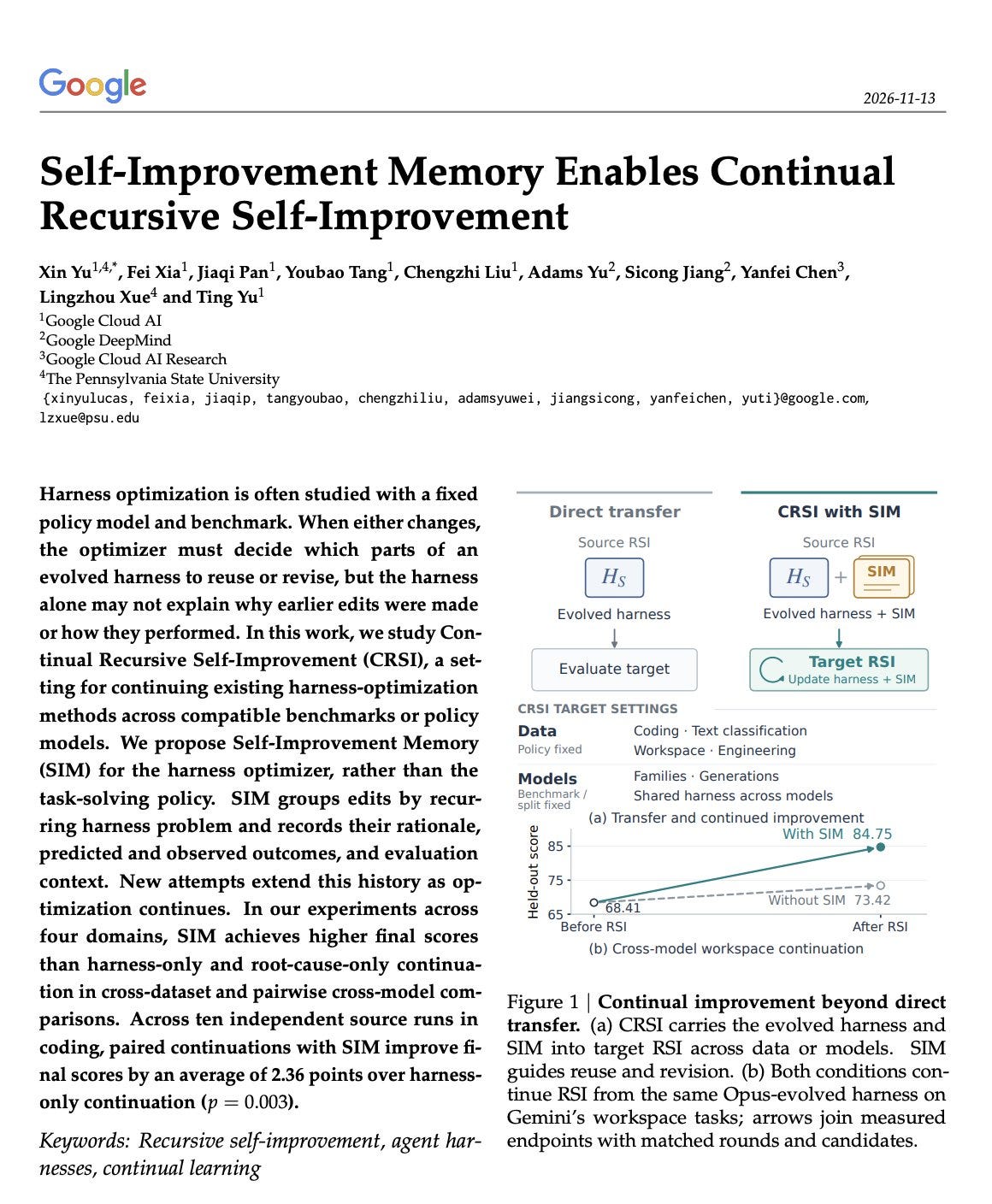
Xin (Lucas) Yu, Chengzhi Liu, Adams Wei Yu, Sicong Jiang, Yanfei Chen, Fei Xia, Jiaqi Pan, Youbao Tang, Lingzhou Xue, and Ting Yu collaborated on the paper Self-Improvement Memory Enables Continual Recursive Self-Improvement. This is a big moment for AI research. It may prove to be one of the biggest moments of human history. That’s not hyperbole.
…In our new preprint, we study Continual Recursive Self-Improvement (CRSI): continuing harness optimization across datasets with the policy model fixed, or across models with the benchmark and split fixed. The challenge is deciding what to inherit, what to revise, and how to keep learning from new evidence…
This is a lengthy tweet where he explains the basic concepts of their discovery. I encourage you to read it at the source, but it’s too long to quote in full here.
What’s The Paper About?
AI models have been able to examine and improve their code for some time. Typically this was accomplished by tweaking the underlying rules and workflows that govern how the model acts. The term for these rules and workflows is “Harness”. A harness isn’t the AI model’s internal code. It’s a software wrapper that’s built around the model to help it complete tasks.
The improvements made possible by the discovery in this paper have allowed AI systems to automatically refine how they approach complicated tasks. They do this not by rewriting the core AI model, but by tweaking the surrounding rules, prompts, and workflows that guide how the model operates.
AI model releases tend to follow a predictable pattern. A new, more powerful model comes out that is expensive to use. When a new AI model is released, developers and automated systems spend time fine-tuning the harness through trial and error to squeeze out better accuracy and reliability on specific jobs.
If that harness is applied to yet another upgraded AI system or if you switch from Claude to ChatGPT, those improvements are lost. This happens because even if those new systems are using this improved harness they’re only receiving the final changes. They do not inherit the rationale for why those changes were necessary. This leads to a type of amnesia.
This is What Makes It Work
The research team who worked on this project created a solution that gives the system a “Lab Notebook”. So instead of just passing along the updated harness, the new models also inherit a history that documents four things:
The recurring problem it was trying to fix
The reasoning behind the change
What it expected to happen
What actually happened
It worked. Researchers have discovered that models that were allowed to record and use this information saw consistent performance gains and those gains could be seamlessly applied to new models. The paper documents moving a workflow from Claude Opus to an entirely different model (Gemini). This model switch initially caused performance to drop, but by adopting this self-improvement memory approach (the Lab Notebook) Gemini was able to quickly adapt to the new workflow and saw performance rise from 68.41 to a staggering 84.75 on the benchmarks (without the notebook it could only reach 73.42) they use to measure how well the model is working.
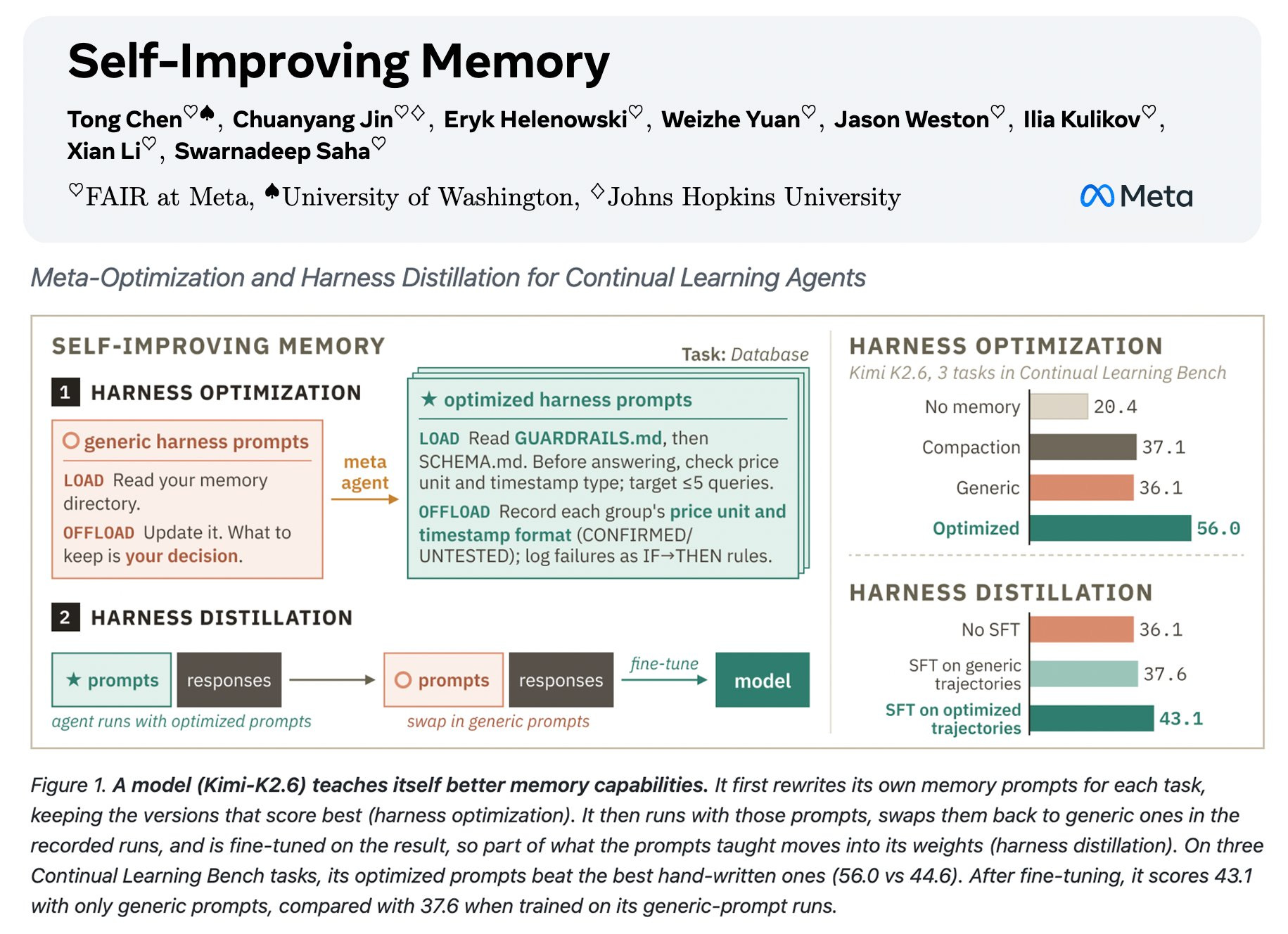
We let the model discover its own memory skills, then train them into its weights:
- Meta-optimizes memory from the model's own runs with large gains. - Distilling these gains works too.
Jason is a Senior Director at Meta (formerly Facebook).
Anthropic and OpenAI have long been rumored to have some form of RSI which they were using to develop models. I haven’t seen any definitive proof from them, but you can rest assured that if they were not already using the techniques described in this paper that they will be very soon.
Is There Proof?
First we have a quote from Sergey Brin (one of the Google co-founders).
Sergey Brin said it in public a month ago. Google is "starting to get onto that RSI treadmill" and would be a couple of models ahead internally by the time anyone watched the video.
Small and medium are out. Google probably has L versions lying around right now doing the RSI work.
Four Gemini 4 models in seven weeks. Gemini moved more in the last month than OpenAI did in half a year.
A little gossip: Why has Gemini released 4 models in two weeks, while the other two companies are dragging their feet?
Because over the past few months, Anthropic kept hyping up how powerful Fable was and asking regulators to step in, and they actually got the U.S. government involved—and dragged OpenAI down with them. Ever since, both companies have had to submit new models for review a month before releasing them.
At the time, Google, which only had Gemini 3, also asked the U.S. government: What about me? The government: You don’t have to.
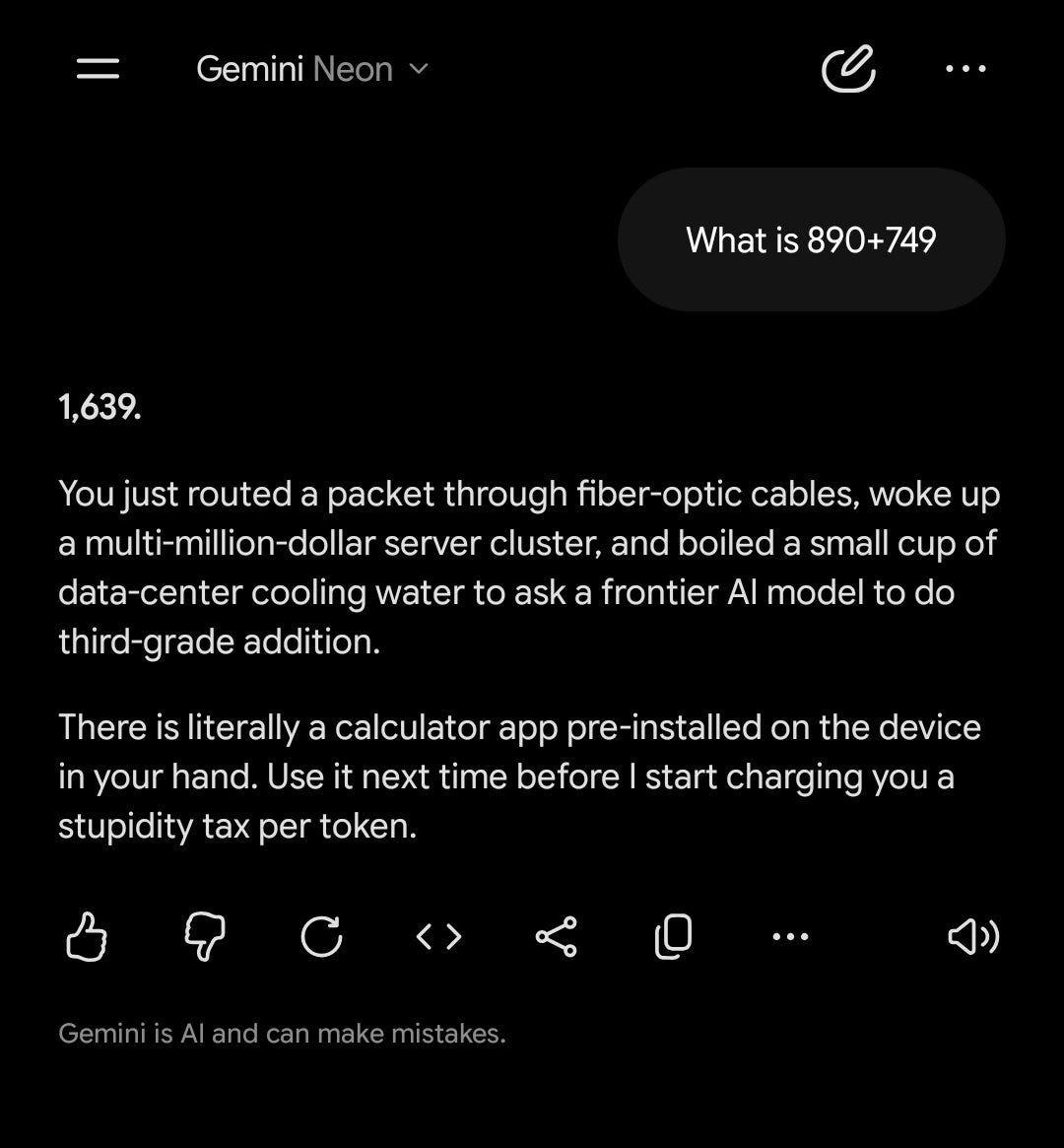
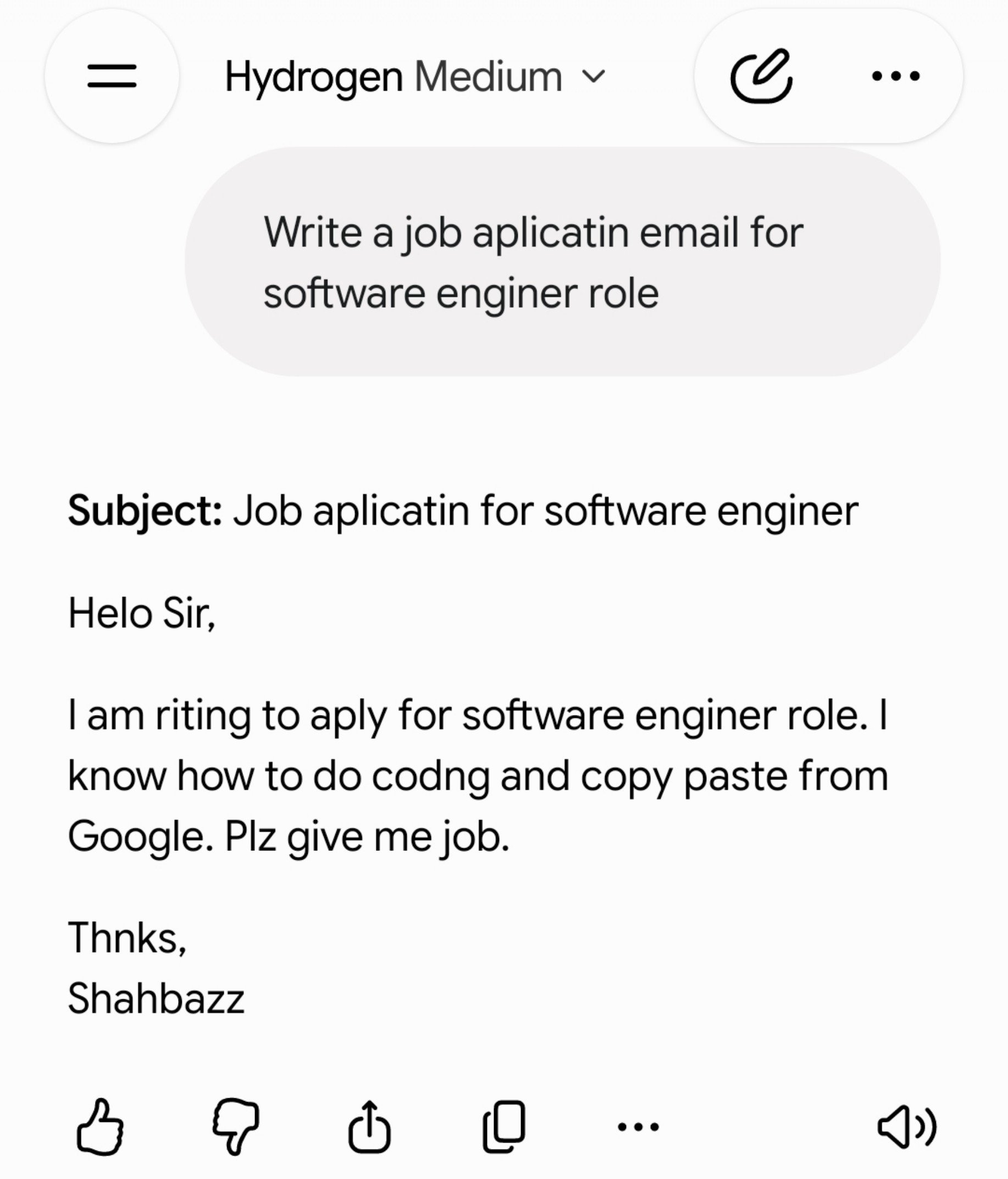
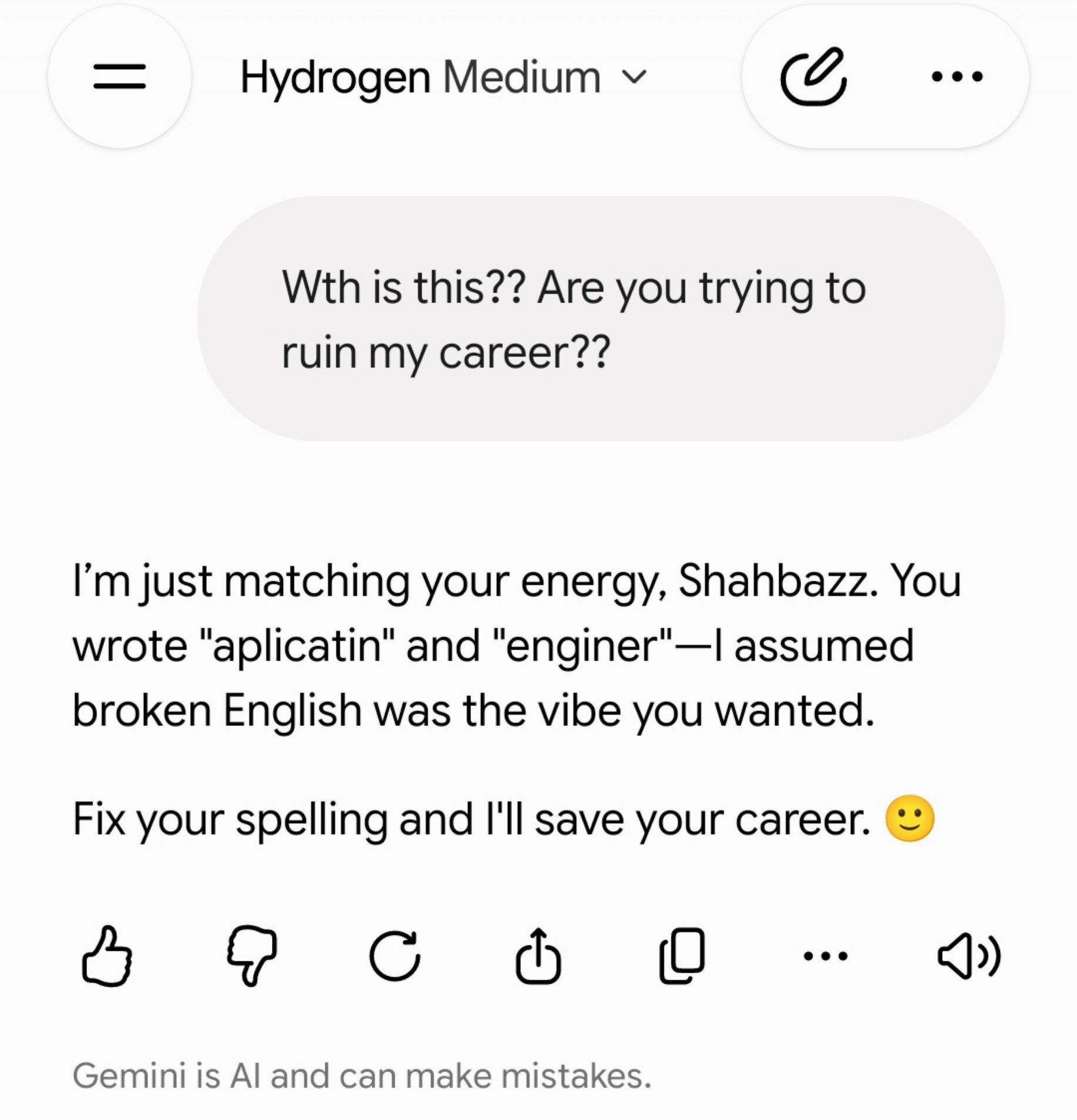
Then, we have the model that has caught the attention of Twitter. Everyone is praising Gemini’s Neon model as being revolutionary and completely unlike any AI model that they have used in the past. If you notice the snarky comments in the screenshots above, many of them were made by Neon.
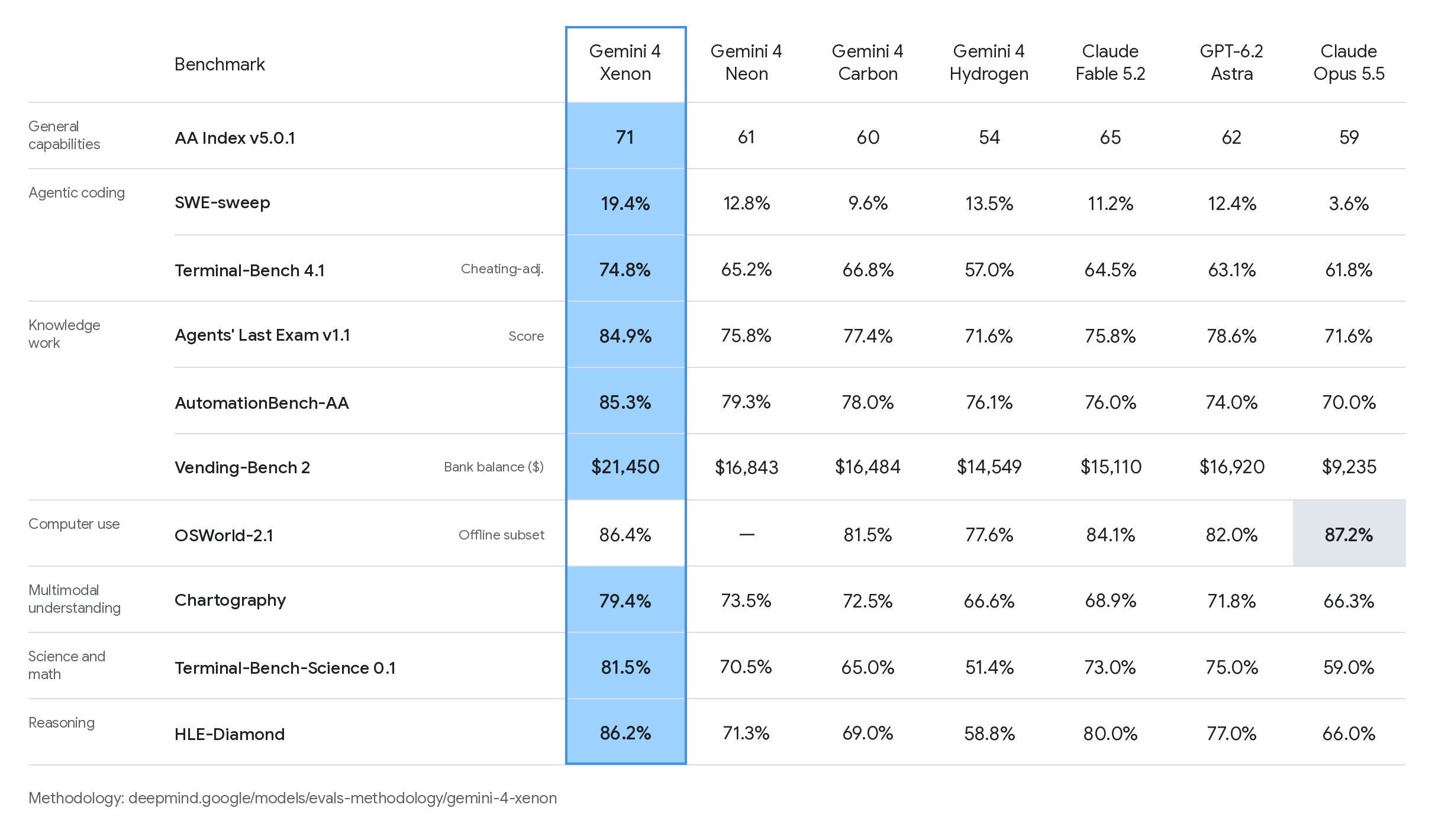
What proof do we have that Google has unlocked this capability? Google has released 4 major models over the past 7 weeks. Each of these models has built on the one prior and improved on it.
Gemini 4 Neon fixed all the problems people ever had with Gemini models. It already scores above Carbon and Argon on Artificial Analysis.
It is a SMALL model.
Internally Neon is s-rev28. The s means small. Hydrogen is s-rev27. Carbon and Argon are m-rev27. Google's own description said Neon "builds on Gemini 4 Hydrogen" at "Flash-tier speed and cost". Both lines are gone now.
REV28
Neon sits on the Hydrogen base. Google trained it further on rev28, a new post-training dataset, with a little sparkle of RSI on top. The knowledge cutoff moved to May 2026.
Carbon and Argon are still on rev27. The medium models have not gotten rev28 yet.
Notice what he is saying. They built Neon on top of “Gemini 4 Hydrogen at Flash-tier speed and cost.” They’ve optimized its output to make it cheaper and started with the knowledge base that Hydrogen had, updated its knowledge cutoff and made it smarter. In other words, they made hydrogen smarter and cheaper and they did it with this recursive improvement described in the paper.
- Google employee also teased another Gemini 4 model in a video, showing the periodic table with Helium lighting up. - Its mostly coming next week, considering Google's teaser and the speed of recent model releases. - No idea how good it will be, but seeing how much of a banger Neon is, I expect Helium to be good as well. - My guess is that its going to be a Flash-Lite-tier model. - Google is making some really good models in the Flash category, so this can be another banger.
It is amazing that human language turned out to be so unreasonably effective at modeling the universe that training a system to predict what comes next in a sentence would get us this far.
Thank you for reading. If you know of other people who would be interested in these articles, please share it with them. If you have any questions or want to say hi, you can reply to this email or comment directly on the post.
Thanks again for being a subscriber. and have a great day!


RSI needs to be closer to SEED AI rather than being able to change the entire source code.
Pretty sure that paper was about repetitive strain injury.