Jensen Huang has resigned from his position as CEO of Nvidia. Everyone is focused on the stock price, the company’s future, and whether this will pop the AI bubble. Those are all good questions, but I think there’s another area that may be harmed by his absence: Open Models.
Jensen was a very vocal advocate for open-source models. Let’s be honest. That was self-serving because for a long time if you were running an open-source model, you HAD to use an Nvidia chip. Apple has been changing that, but the CUDA moat is still real and the only place you can get CUDA is through Nvidia.
Nvidia, under Jensen's leadership, invested heavily in the open-model ecosystem. One beneficiary of their investments was Hugging Face, the world's largest repository of open AI models. In September 2026, Nvidia announced plans to acquire Hugging Face for around $13 billion.
Huang also championed Nvidia's development of Nemotron. That’s the name for their family of open-source AI models. The company committed billions to developing increasingly capable models, including Nemotron 4, with the ambition of competing at the frontier of open AI development.
His absence changes all of that.
That’s what we’re going to look at this week.
Opposition to open models from the frontier labs
The role of government
Apple continues to improve its AI ecosystem for the hardware.
steve jobs watching jensen huang appoint a pepsi ceo to his board of directors
Missing Context (if you need it): Steve Jobs and Apple’s board brought in former Pepsi CEO John Scully to serve as CEO of Apple. Shortly after that, Scully fired Steve Jobs from the company he helped co-found in 1985.
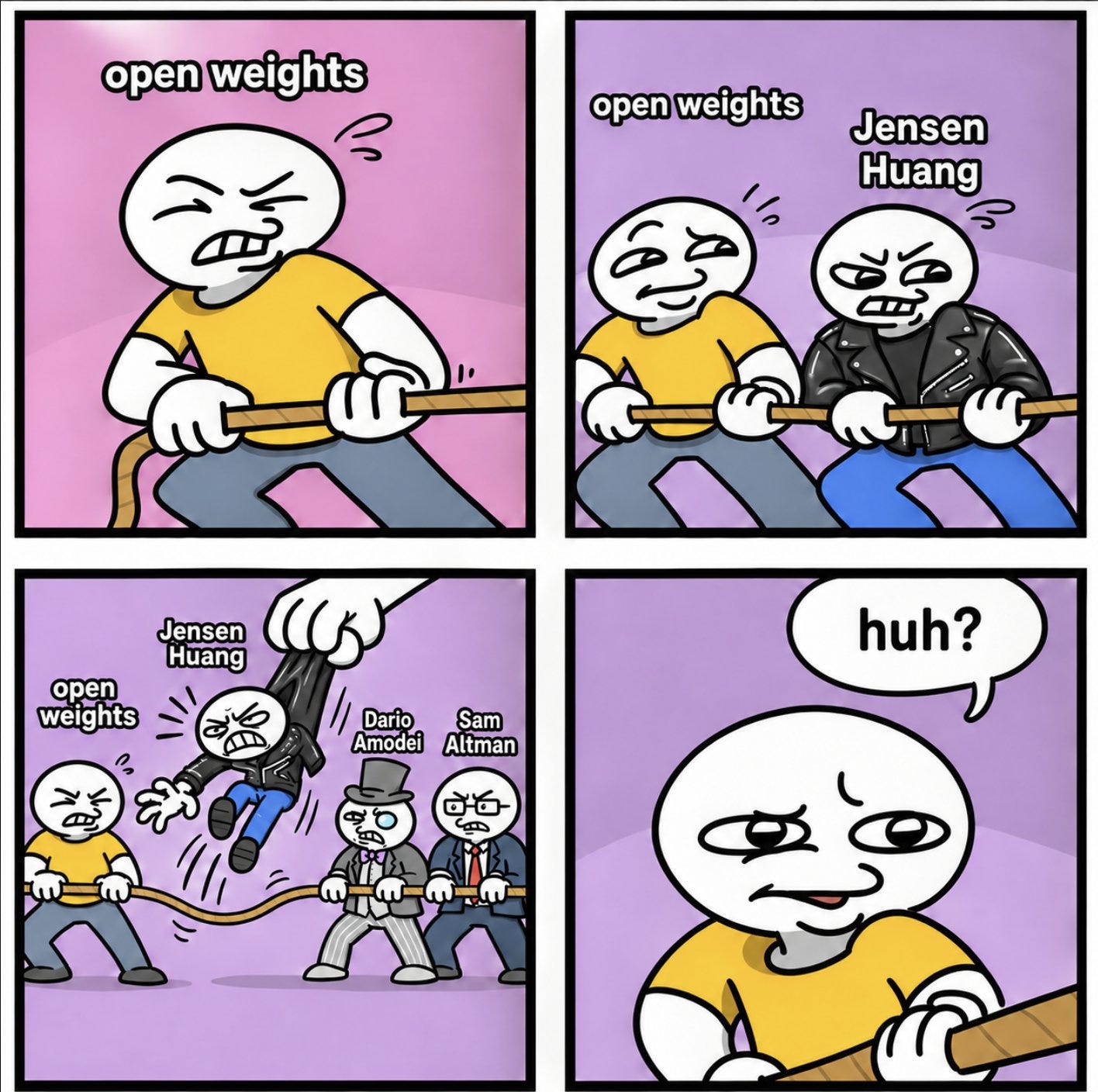
>Jensen Huang gets ousted from Nvidia literally 12 hours ago >OpenAI and Anthropic immediately form an alliance to back congress to ban AI chip exports to china
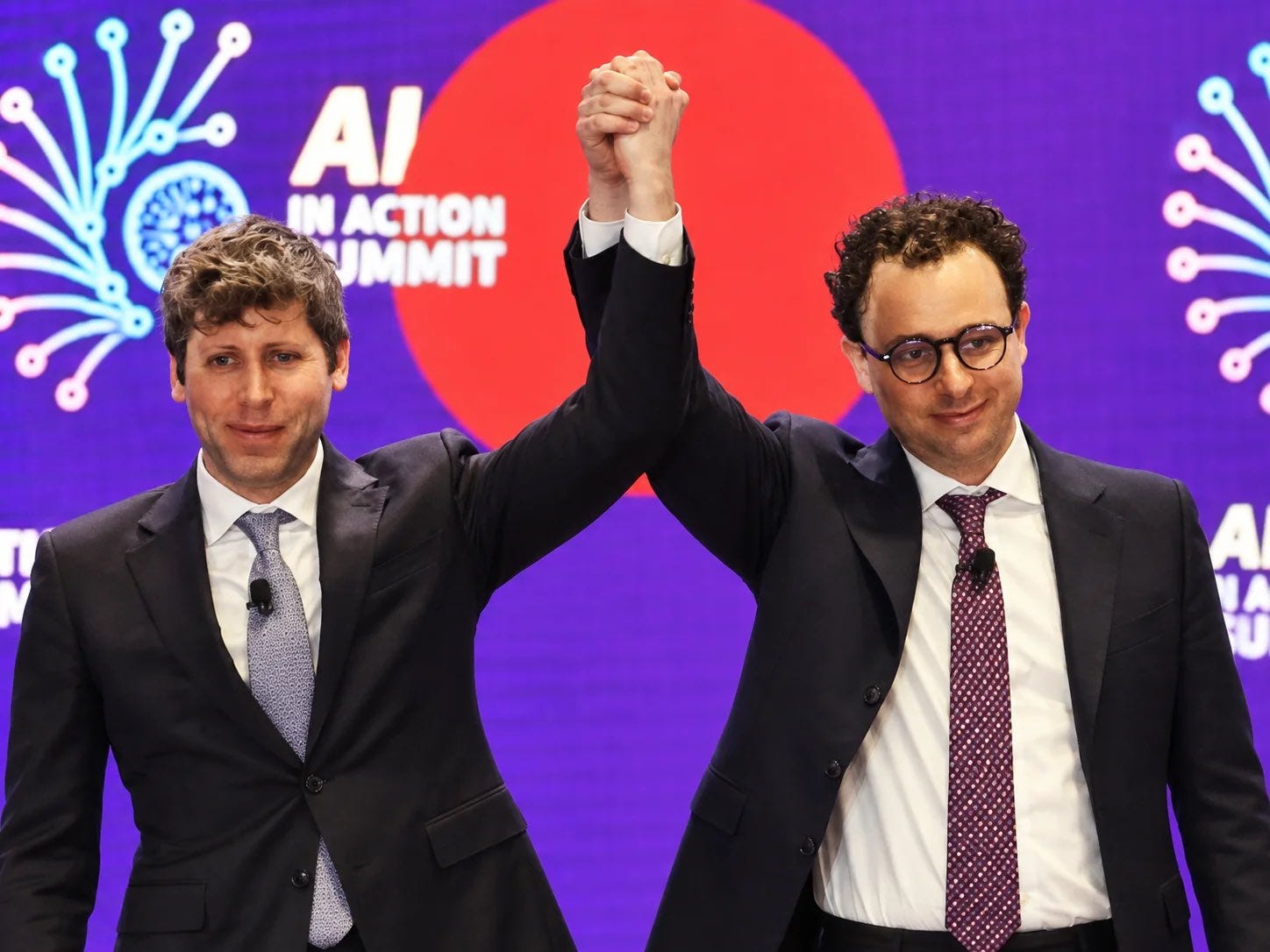
“Anyone who has read my past writing should know that I don’t regard such bans as a useful measure, but let me state it clearly so that there is no doubt: Anthropic has never advocated for a ban on open-weights models,” he wrote, emphasis his own.
His response came after Nvidia founder and CEO Jensen Huang took to X (his first post on the platform) to share an open letter on Friday in which Nvidia and a long list of other AI companies including Hugging Face, Meta, Microsoft, Mistral, and Nvidia urged policymakers not to impose broad “premature restrictions” on open-weight AI models.
He then goes on to state:
Amodei said in the blog post published Monday that he views open-weight models as falling into a different bucket than the threat China poses. “Open-weights models that don’t have dangerous capabilities are a public good: they don’t cost anything besides the compute needed to run them, and they provide value to businesses, developers, and researchers.”
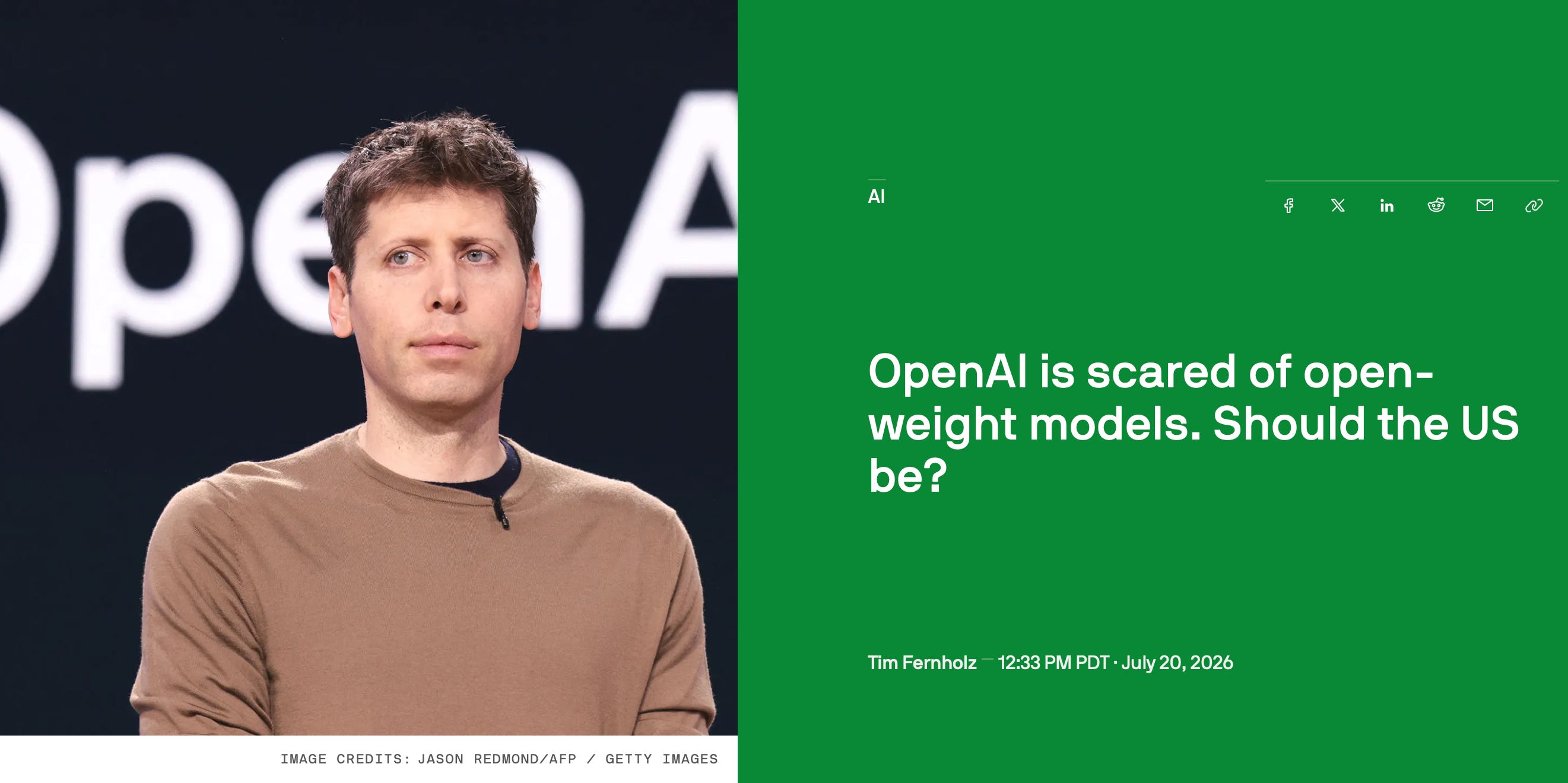
TechCrunch Documents OpenAI’s Strategy Against Open-source Models
It’s difficult to find tweets from Sam Altman or OpenAI where they are as transparent as Dario Amodei above. They generally exercise more control over their messaging. That control slipped a year ago when Dean W. Ball said the quiet part out loud. TechCrunch has a good write-up about it and the context of that time which prompted the statement.
OpenAI’s head of strategic futures, Dean W. Ball, went so far as to argue that the U.S. government should find a pretext to create regulatory fear, uncertainty, and distrust around the new models, since open-weight models must necessarily deter capital spending by the frontier labs.
People freaked out, with tech luminaries like Yann LeCun and Martin Casadoarguing that open software can accelerate innovation and coexist with proprietary projects. Ball soon retracted his claims that a regulatory crackdown was the White House’s “best strategy” and that open-weight models necessarily slow down advances in the technology.
The article is a year old, but every now and then you can see these same attitudes persist. Give it a read and decide for yourself. The full article is here.
Why Do Open-source Models Matter?
Open-source models provide access to expertise and intelligence that has never before been easily available to the common man. Rich people have always had access to experts, to specialists, to people who can fix their problems. They simply hire the right person to make their lives easier.
Open-source AI is the first time when anyone on the planet who has access to hardware capable of running a local model can gain similar insights. Granted the cost of the hardware is still an issue, but even a recent model iPhone or Android phone is able to run basic AI models. And as this movement matures we’re finding that some labs are creating specialized models which are smaller in size and more tailor-made to specific interests which makes them even more accessible.
Running a model locally allows you to avoid the very things that Dario Amodei listed as a benefit:
“You can revoke a user’s access. You can change what the model is willing to do.”
They can’t do that if it’s on your own hardware. And that’s why this fight matters.
Government Interference
One of the more reasonable approaches used by individuals who want to restrict Open Models is to insist on strict government oversight for every release. I can understand the rationale. Some of these models are powerful and can be used with ill intent.
I’m sure it’s possible to come up with a policy that works, balances the need for safety with the speed of innovation. I believe that’s possible. I don’t believe we are there yet. As proof, consider OpenAI.
it's been 2 months and 13 days since Open AI released a new frontier model
This is the longest they have ever waited between major updates. During that time Anthropic has released Opus 5.5 which by all accounts is better than OpenAI’s Astra (their current leading model). And recently Anthropic furthered their lead even more by announcing Fable 5.2.
OpenAI is in a “safety lockdown” on its frontier work, tightening safety measures and containment protocols to avoid another Hugging Face incident. Training continues under much stricter controls.
Most gains come from video games and extreme sandboxes where models must complete clear, difficult long-term goals. These force planning, experimentation, recovery from failure, and strategy discovery, driving intelligence and creativity.
Public research roles match this: Synthetic RL uses self-play and simulators; agent teams focus on sustained execution and multi-model coordination; the Recursive Self-Improvement team builds systems that generate hypotheses, run experiments, and automate research.
The internal model is still training but nearing completion. The jump is enormous. narrow superintelligence in specific areas and overall AGI-level capability. Its ability to independently handle difficult work sets it apart.
Click through to read the full tweet. This post runs through all of the major labs and lists the rumors about what they are working on. Obviously this is gossip, but it sounds like plausible gossip and, in the case of OpenAI, I believe it’s well-founded gossip.
Confirmation?
OpenAI employee Roon kind of confirms that the government is what’s holding up the release of ChatGPT’s newest model.
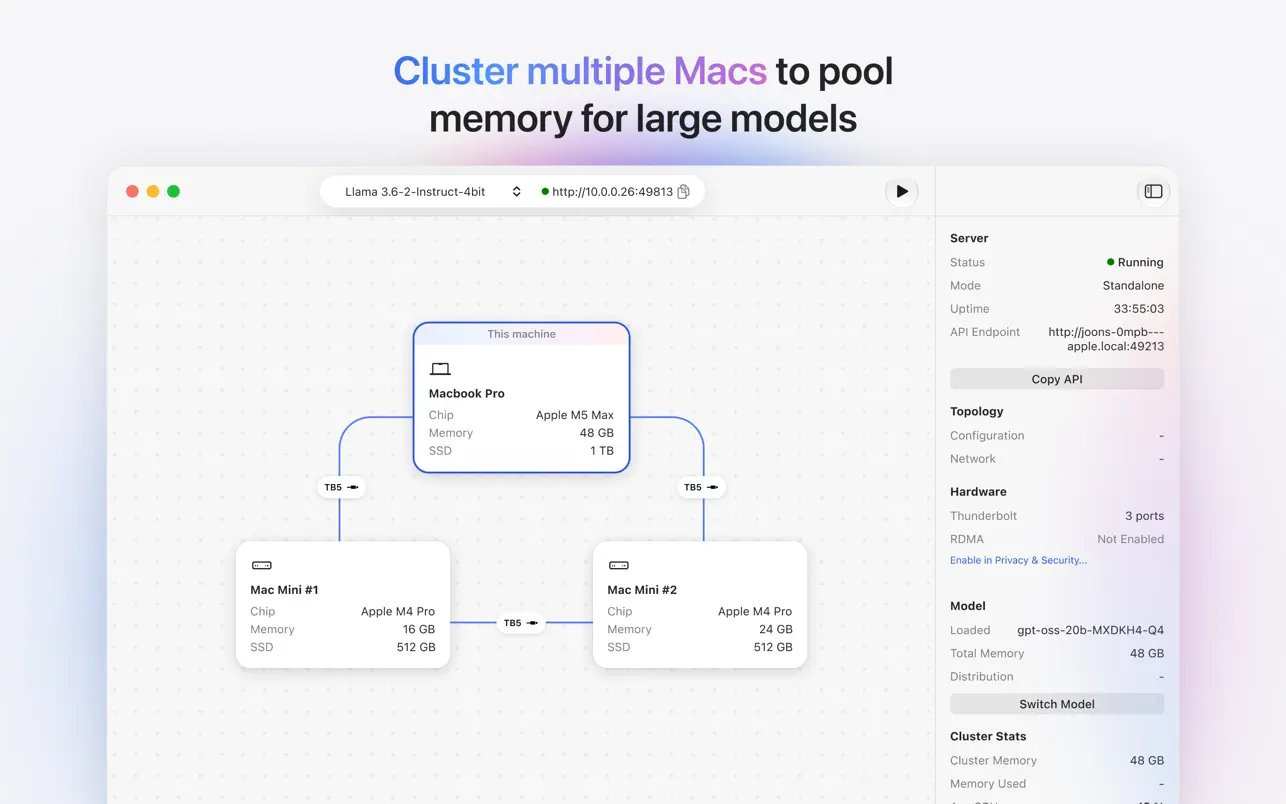
Harbor turns your Mac into a private AI inference server. Run open-weight models locally on Apple silicon—your data never leaves your hardware, and nothing reaches the cloud. Connect multiple Mac computers over Thunderbolt 5 to pool unified memory, enabling large models and higher concurrency that a single computer can handle alone.
Set up in minutes, not hours Harbor automatically detects your devices over Thunderbolt 5 to form a cluster. Plug in, start, and you’re running—no manual configuration, no command line, no infrastructure expertise required.
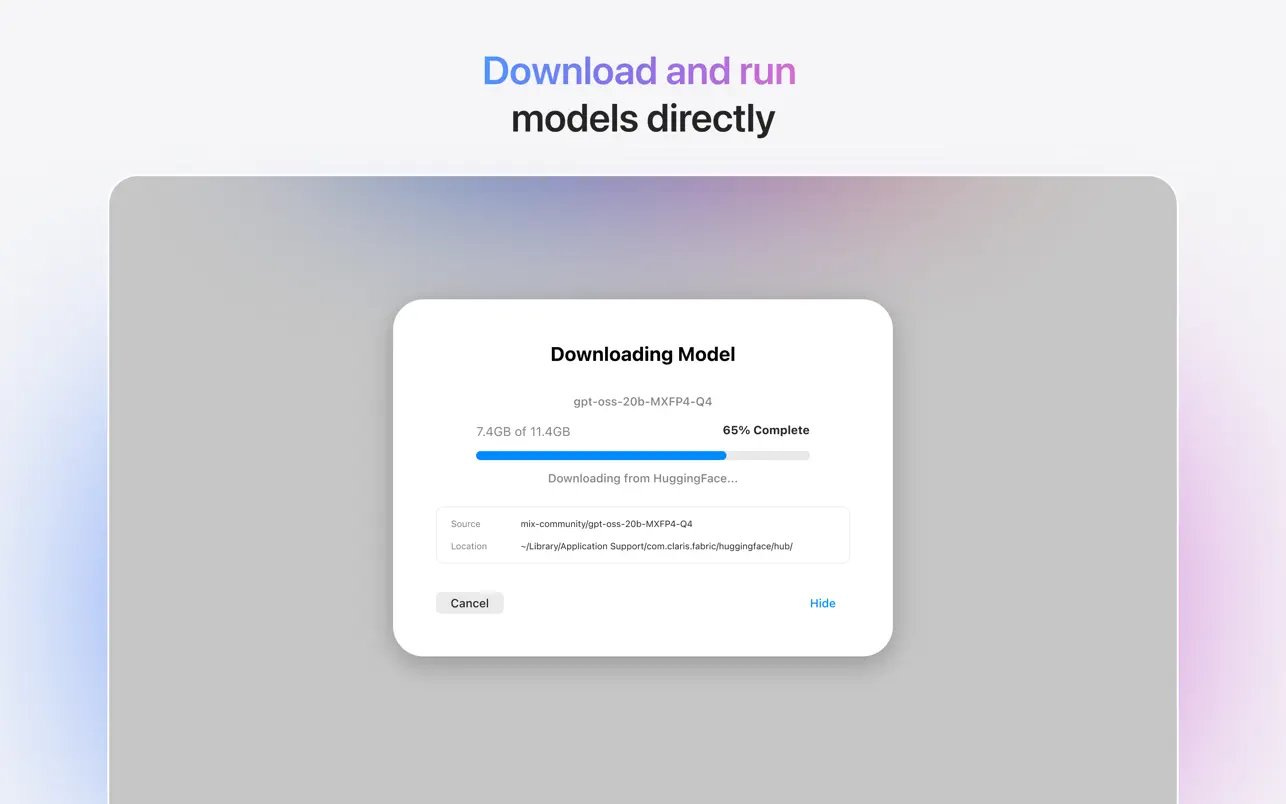
Download and run models directly Browse, download, and load open-weight models from within the app. Harbor handles model management so you can focus on the work, not the setup.
Cluster for scale Connect two or more Thunderbolt 5-capable Mac computers and Harbor pools their unified memory into a single inference resource. Run models that exceed any single computer’s capacity, or serve more concurrent requests across your cluster.
Harbor is currently in a private preview under the Claris brand.
This seems to be something similar to LM Studio or Ollama with a twist. If you have multiple Apple devices running Apple Silicon you can daisy chain them together to run larger models than you could run on any single device. The software will treat all of your disparate devices as one large device with shared memory.
Last month, Apple announced its plans to tighten macOS privacy controls around Full Disk Access amid the rise of “increasingly capable and autonomous” AI agents. With today’s new macOS 27.3 beta, Apple is implementing several changes as part of this…
In macOS 27.2, “Device Control and Data Access” is a unified toggle in System Settings, where Apple says that apps with that level of access can “view and send email, edit contacts and photos, monitor your keyboard, track websites, record your screen, control any app on your Mac, and more.” In macOS 27.3, Apple is splitting “Device Control and Data Access” into two categories:
Accessibility: Intended specifically for assistive technologies, with permissions handled through an entitlement process.
System and App Protection Override: A new category for apps that need to bypass certain macOS protections to control other apps or perform automated tasks.
For the latter, users will be able to specify which apps an automation tool can access rather than granting it unrestricted control. For instance, you could give an app access to the Mail app, but not Messages. macOS 27.3 also adds an option for users to require an app to request permission every time it needs access, rather than granting it access indefinitely…
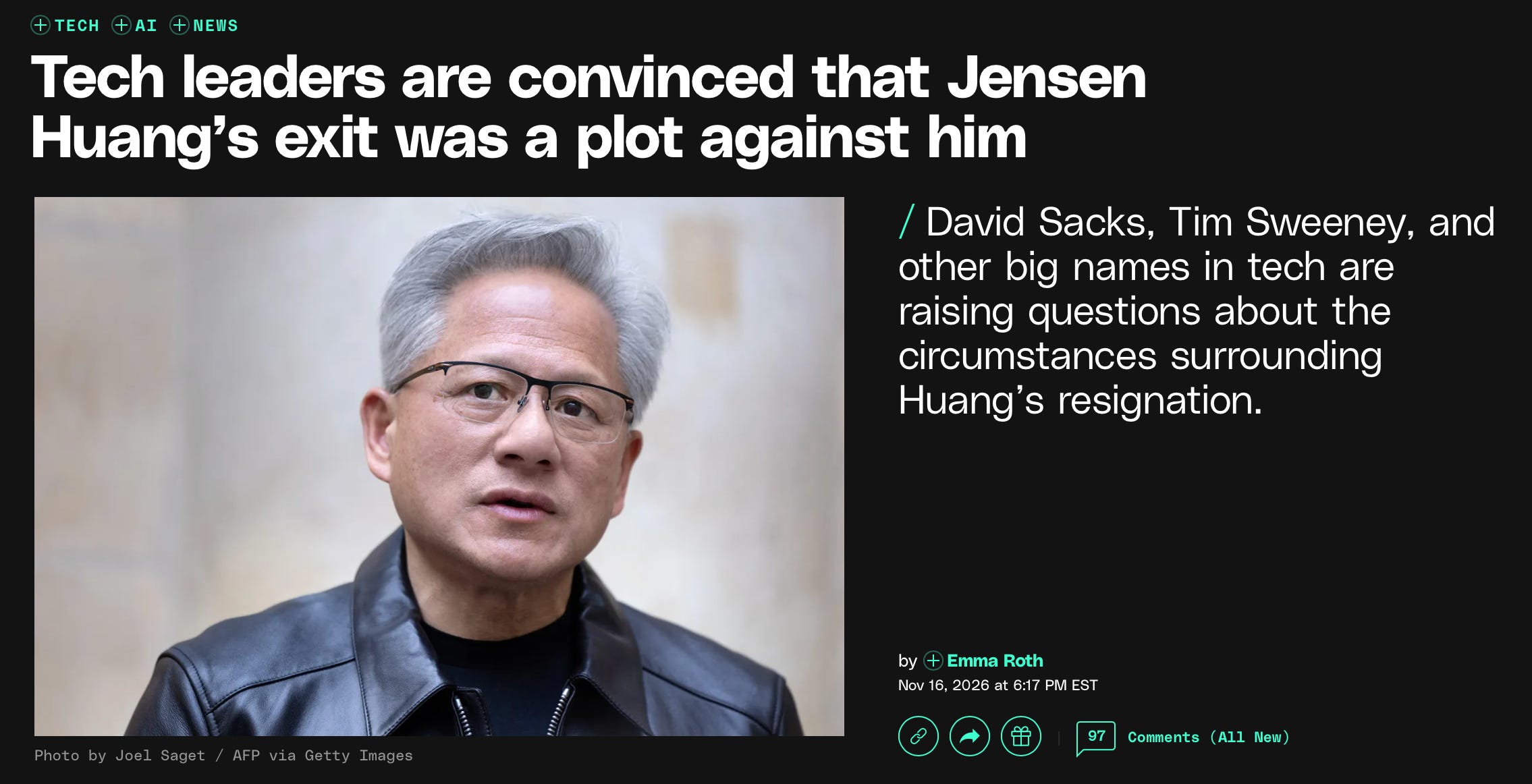
In this article various tech luminaries look at reporting from the New York Times and others and consider the fact that no government agency has been willing to confirm that Alice Huang is a Chinese spy. Their contention is that Huang was set up.
Set up might be pushing it because he is guilty of the affairs. I do think he has organizations and individuals who benefit from his removal and it’s not much of a stretch to imagine them orchestrating when these ‘news items’ leaked and arranging for the timing to happen when it could do the most damage… as it seems to have done.
Thank you for reading. If you know of other people who would be interested in these articles, please share it with them. If you have any questions or want to say hi, you can reply to this email or comment directly on the post.
Thanks again for being a subscriber. and have a great day!






Discussion about this post